What Is a Mouse Wrist Rest and Which Types Do Buyers Stock?
A mouse wrist rest is a small supported cushion that sits in front of, or beneath, the mouse area and keeps the wrist in a straighter position during desk work. That single sentence covers a product family that spans memory foam pillows, cooling gel pads, crystal gel sets, and combined mouse-plus-keyboard bundles, and the differences between them decide how the product sells, who buys it, and how often it gets reordered.
This guide is written for office supply distributors and ergonomic product retailers who stock the category rather than use it. It covers what a wrist rest actually does ergonomically, why the category earns its shelf space, which types buyers should carry, how to specify quality when ordering, and the sourcing terms behind a healthy margin.
Key takeaways before you read further:
- Function: the rest keeps the wrist nearer to neutral alignment and off the hard desk edge, which reduces the pressure points associated with long mouse sessions.
- Core types: memory foam for comfort, gel for cooling, crystal gel for a premium feel, and mouse-plus-keyboard sets for workstation bundles.
- Quality markers: slow-rebound foam, smooth wrinkle-free cover fabric, base antiscivolo, and a support height that matches standard mouse dimensions.
- Sourcing terms: MOQ (Minimum Order Quantity) 100 pcs on existing molds, 10 to 15 day OEM lead time, 1.5 million pads monthly capacity.
What Is A Mouse Wrist Rest
The mechanics are simple enough to explain in one breath. Resting the heel of the hand or the wrist directly on a hard desk concentrates body weight on a small patch of tissue over the carpal tunnel, while cocking the wrist upward to reach the mouse. A wrist rest replaces that hard edge with a compliant surface at roughly mouse height, letting the hand stay closer to neutral while the mouse glides above it. Users feel the difference within an hour; office managers hear about it within a week.
The research context matters for retail copy as much as for ergonomics. The US National Institute for Occupational Safety and Health studies musculoskeletal disorders among computer workers, and its parent agency maintains the reference material on workplace factors behind wrist and hand complaints. Distributors writing product descriptions can anchor claims in that body of work through the NIOSH resources rather than inventing medical language, which keeps listings both persuasive and defensible.
One clarification saves a hundred support conversations: a wrist rest supports, it does not cure. Products that promise medical outcomes create return traffic and regulatory attention; products that promise comfort and neutral posture sell through and get reordered. The strongest listings in this category describe materials and geometry, not treatment.

Why Distributors Stock Wrist Rests
The category earns its place in an office assortment through attachment rather than hero sales. A customer buying an office mouse or a desk mat is already in the frame of mind that sells a wrist rest, and the price point sits low enough to add to almost any basket without a approval step. Retailers who merchandise the two together report the pattern every ergonomics vendor knows: the pad sells the rest, and the rest lifts the pad’s average order value.
Corporate procurement repeats the story at contract scale. Workstation equipment is a recurring budget line, wellness programs need visible artifacts, and a wrist rest is among the least expensive items that reads as an ergonomic upgrade. In our corporate gifting program, ergonomic sets routinely accompany larger pad orders for exactly this reason: they round out a desk package at a modest incremental cost.
The category also travels well alongside the volume business. Distributors running blank mouse pad programs through our wholesale blank channel can add wrist rest SKUs to the same containers, the same inspections, and the same vendor relationship, which keeps the landed cost of a low-ticket item from being eaten by standalone freight.
A wrist rest rarely wins a sale on its own. It wins by riding along with three other products in the basket, quietly widening the margin on all of them.
Core Types Buyers Stock
The type decision is a customer decision: different users want different feels, and a distributor who carries only one type serves only one temperament. The four families below cover the practical range, and each earns its slot through a distinct selling point rather than a price gap.
| Type | Feel And Selling Point | Best Fit Customer |
|---|---|---|
| Memory foam | Slow-rebound cushioning that shapes to the wrist | General office staff, longest comfort sessions |
| Cooling gel | Gel core that stays cool under the palm | Warm offices, users who dislike foam heat |
| Crystal gel | Transparent gel with a premium visual finish | Design-led buyers, gift and premium sets |
| Mouse + keyboard sets | Matched pair covering the full workstation | Corporate procurement, bundle builders |
The set logic deserves a note of its own. A mouse wrist rest solves half of a desk; the keyboard side has the same pressure problem and a matching product in our keyboard wrist rests line. Buyers who stock the pair capture the full workstation sale, and the matched aesthetic of a set photographs better in catalogs than two products bought at different times from different vendors.

Building an ergonomic assortment for office supply customers? Send us your SKU plan and target markets. Our team confirms the product mix and returns a quotation within one working day.
MOQ 100 pcs | RoHS and CE certified | DDP to Amazon FBA
Matching Wrist Rests To Customer Segments
The same four product families sell differently depending on who walks into the store or opens the catalog, and a distributor who segments the assortment up front merchandises it with less guesswork. Office supply resellers serve end users who buy on feel and price, so memory foam at an accessible price point does the volume while one gel option catches the comfort upgrade. The packaging can stay plain, because the buyer is solving a personal discomfort, not furnishing a brand.
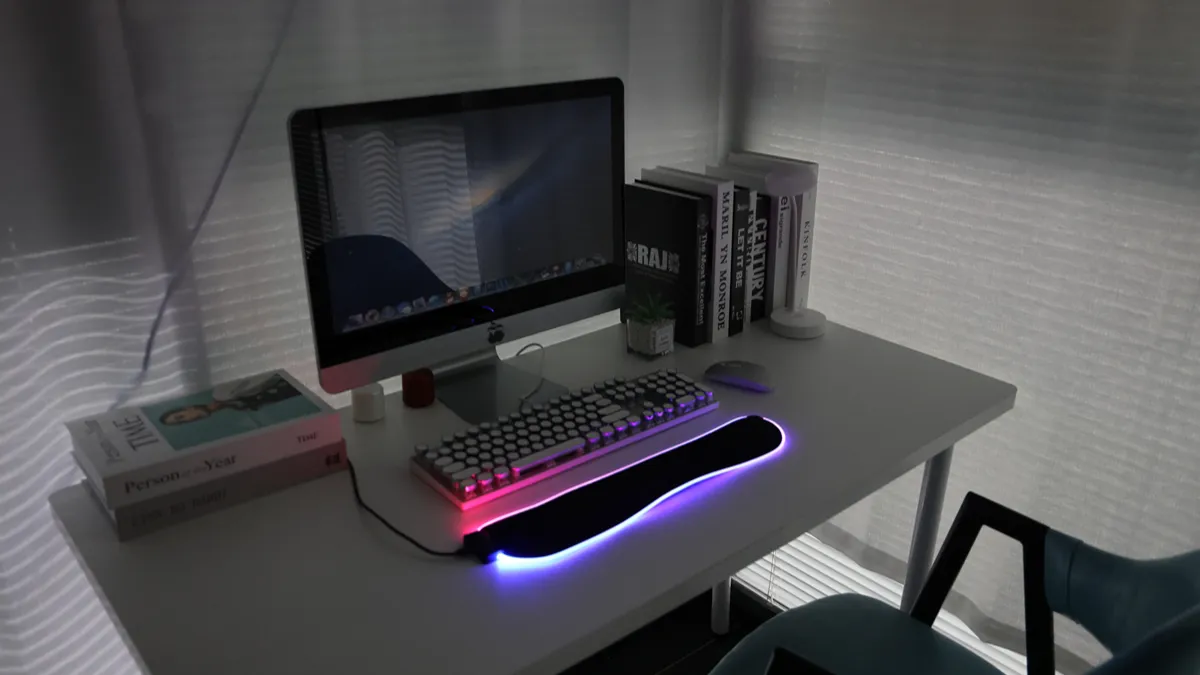
Ergonomic product retailers face a more informed customer who arrives with a wrist complaint and a budget, so the assortment needs visible quality markers: better cover fabric, stated foam density, and honest size labeling. This is also the channel where an illuminated or premium-finish option earns its slot, because a customer investing in their workstation is already past the cheapest-fix stage of the journey.
Corporate and promotional buyers behave differently again. They purchase in sets, they need logos on the products, and they care about the vendor questionnaire as much as the product, which is where the audit trail covered above becomes a selling point rather than paperwork. For this segment, quote the matched mouse-and-keyboard set as the default unit and treat single rests as the add-on, because the workstation bundle is what procurement actually approves.
One merchandising note ties the segments together: keep the type names consistent across channels. Memory foam, cooling gel, and crystal gel mean the same thing to every buyer, and consistent naming makes your catalog easier to search, your reorders easier to specify, and your returns easier to diagnose.
How To Specify Quality
Wrist rests fail in the hand, not on paper, so the specification has to describe the hand experience in measurable terms. For foam, the marker is rebound speed: press the rest for five seconds and watch the dent close slowly rather than snap back or linger permanently. Cheap foam feels fine in week one and bottoms out by month two, which is a return with a delay. Our ergonomic lines use slow-rebound memory foam specified for repeated compression.
The cover fabric decides the first impression and the first complaint. A smooth, wrinkle-free knit or fabric laminate reads as quality on the shelf and survives daily skin contact; loose fabric over gel wrinkles within weeks and photographs badly in customer reviews. Check the seam construction along the bottom edge as well, because that seam takes the shear load every time the rest shifts on the desk.
Geometry is the third specification block. The support height should keep the wrist level with the mouse buttons rather than propping the hand upward, the base needs a non-slip layer that holds on polished desks, and the footprint should suit both compact and full-size mouse areas. Retailers can see the dimension logic applied across our mouse wrist rests collection, where each SKU states its size class for exactly this comparison.
Run two bench tests on the sample before approving an order. Slide test: push the rest sideways on a smooth surface with moderate force and confirm the base grips instead of gliding. Wash test for fabric covers where offered: follow the care instructions once and check for shrinkage or seam puckering. Both tests cost minutes and predict the two most common reasons this category comes back.
Sourcing Terms For Wrist Rests
Wrist rests run on the same commercial rails as the rest of the catalog, which simplifies vendor management for distributors who already buy pads here. MOQ starts at 100 pcs on existing molds, OEM lead time runs 10 to 15 days once the specification is locked, and two production bases with 1.5 million pads of monthly capacity cover reorder volume without a separate negotiation. Custom shapes, branded covers, and private label packaging are quoted through the OEM and ODM process like any other product family.
| Order Parameter | Standard Offering |
|---|---|
| MOQ | 100 pcs on existing molds |
| OEM/ODM lead time | 10 to 15 days after specification lock |
| Monthly capacity | 1.5 million pads across two bases |
| Branding | Surface logo printing, retail packaging, barcode labeling |
| Fulfillment | DDP (Delivered Duty Paid) to Amazon FBA (Fulfillment by Amazon) |
Quality control follows the standard sequence every order passes through here: incoming material inspection, first-article confirmation, in-process sampling, full inspection of finished units, and an outgoing check before loading. Factory-level ISO 9001 and ISO 14001 certification with BSCI and GSV audit coverage backs the process, which matters for office supply chains that pass vendor questionnaires down to their retail customers.
Domande frequenti
What Does A Mouse Wrist Rest Actually Do?
It keeps the wrist closer to neutral alignment during mouse use and cushions the pressure of resting on a hard desk edge. It is a comfort and posture product, not a medical device, which is how the best retail copy positions it.
Which Wrist Rest Types Should A New Buyer Stock First?
Start with memory foam and one gel option, then add a mouse-plus-keyboard set for corporate customers. That trio covers the majority of preferences with three SKUs instead of ten, and reorder data will tell you whether crystal gel belongs in the second order.
What Is The MOQ For Custom Wrist Rests?
Custom branding on existing molds starts at 100 pcs, with OEM lead time of 10 to 15 days after the specification is locked. Fully custom shapes and new molds are quoted individually after a feasibility review.
Are Wrist Rests Sold In Mouse And Keyboard Sets?
Yes. Matched sets cover the full workstation and sell strongly into corporate procurement, and the matched pair photographs better in catalogs than two separately sourced products. Both sides of the set can carry the same branding and packaging.
Can Wrist Rests Ship Together With Mouse Pad Orders?
Yes. Consolidating wrist rests with pad orders in one container keeps freight proportionate for a low-ticket item, and the same quality control sequence and audit coverage applies to both product families from the same vendor.
A mouse wrist rest is a small product with a straightforward job: hold the wrist near neutral, feel good for a full workday, and last long enough to be reordered. Distributors who stock the right types, specify quality in measurable terms, and consolidate sourcing with their pad vendor turn that small job into a steady attachment business.
Sanxing Tech manufactures wrist rests on the same in-house lines as its pad range, with 20 years of production history and 1.5 million pads of monthly capacity behind delivery. Send your assortment plan, and our team will return a product mix recommendation with a quotation.